Technology
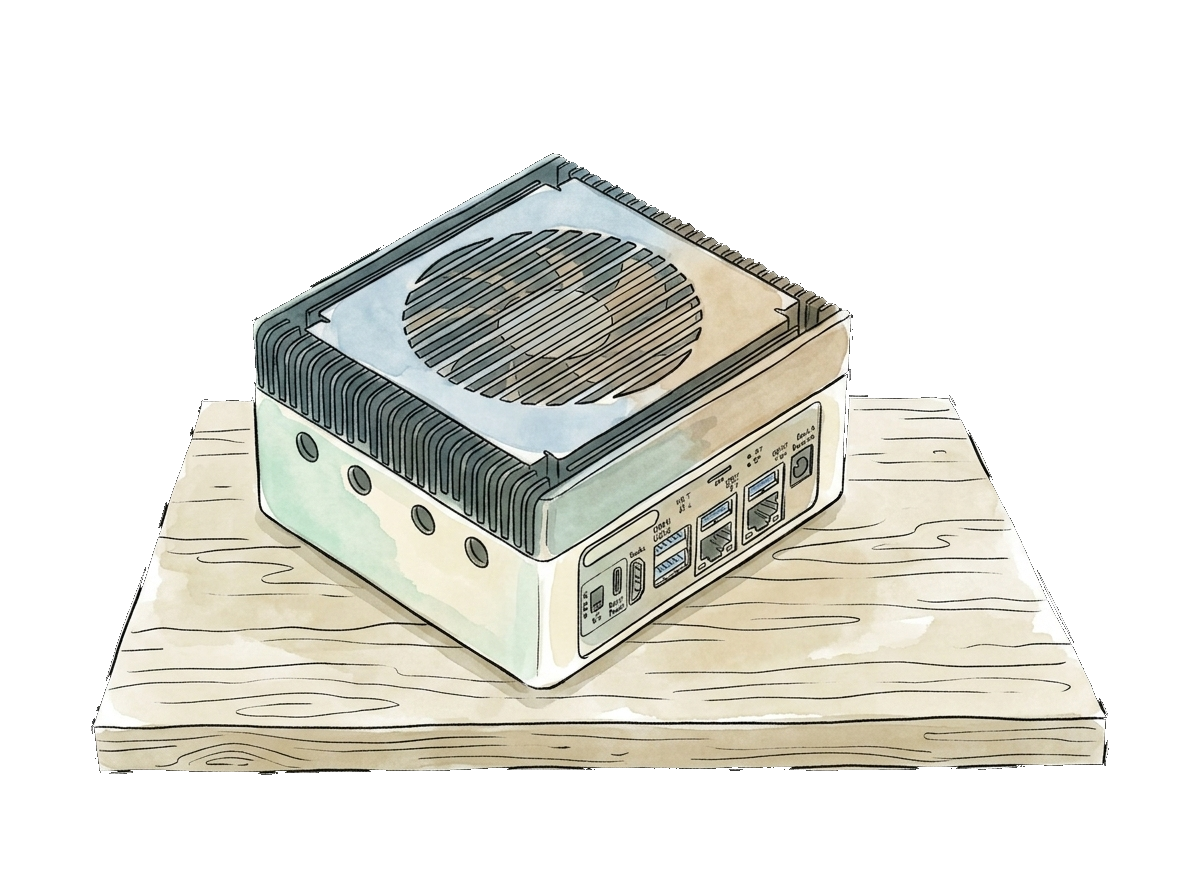
More AI compute than a typical camera. Less exposure than cloud inference. Camera images stay on a private local network. This page is the technical design we are building — not a shipped spec sheet.
In development. First home pilot being prepared. Camera counts, UPS runtime, and model names will be published only after they are measured.
The three common architectures
| Architecture | Advantage | Trade-off |
|---|---|---|
| In-camera AI | Private, low latency | Very limited compute budget |
| Cloud AI | Large models, easy scaling | Imagery or derived data leaves the premises; vendor and internet dependency |
| Ilonai local AI appliance | Much more compute than a typical smart camera, imagery stays local | Requires a local compute box and a dedicated network |
That middle ground is the technical story. For a general audience we call it context-aware local AI. For technical readers, if this remains accurate as we ship: a fine-tuned multimodal / vision-language model on dedicated local hardware. We do not put model brand names on the customer homepage.
System diagram
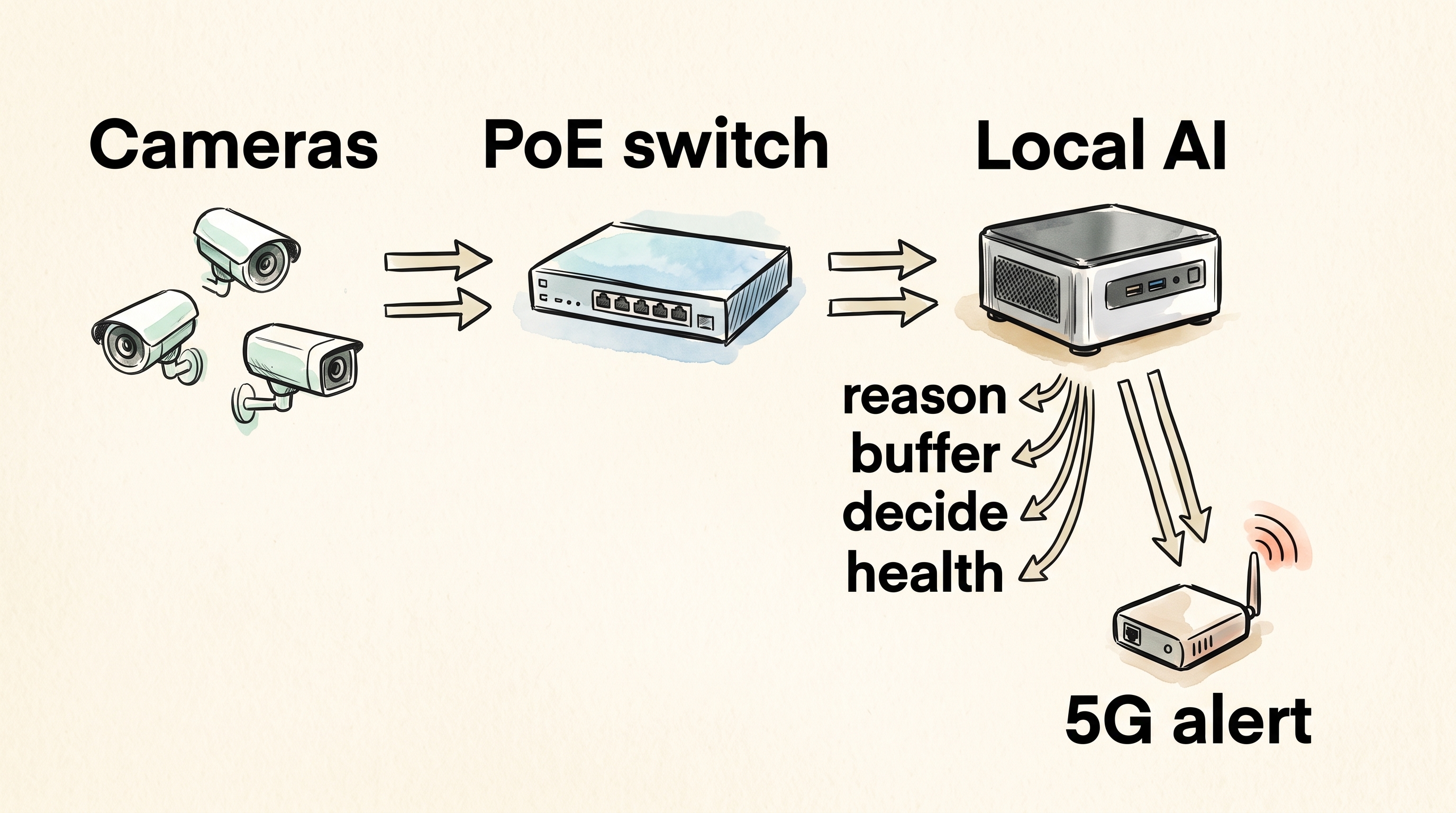
Your home or facility Wi-Fi does not need to become a surveillance network. Cameras are not meant to sit on ordinary household Wi-Fi or to require a camera-vendor cloud account.
Why centralized local compute?
More AI capability than a typical camera, less privacy exposure than cloud inference.
Putting a tiny detector in every camera is convenient and private, but the model has to fit a small processor. Sending video to a large cloud model is capable and operationally easy, and it moves sensitive imagery off site.
One (or a few) local AI nodes can serve many inexpensive cameras. Intelligence lives on the box; the camera can remain a replaceable sensor. We will publish home-node and facility-node camera ranges only after decoder, network, and model benchmarks exist. We will not promise “50 cameras easily” in advance.
For facilities, multiple compute nodes are the intended failure domain: one hardware fault should not disable an entire building.
Cameras: standards-based, approved list
We are not building a proprietary camera cloud.
Intended properties:
- approved PoE network cameras
- local IP networking
- standard local video protocols (RTSP / ONVIF class)
- cameras replaceable without rebuilding the AI system
- no camera-vendor cloud required for core detection
Benefits we are designing for: lower per-room hardware cost at scale, simpler replacement, less lock-in, facility-standard cabling, and the ability to keep the camera “dumb” while Ilonai owns the decision.
We will qualify models for power-cycle recovery, RTSP reconnects, night mode, image quality, and stability. We do not promise arbitrary third-party camera compatibility.
Do not read “smart camera” here. That phrase usually implies a vendor app, cloud account, and remote viewing. Ilonai’s direction is the opposite.
Isolated network and cellular link
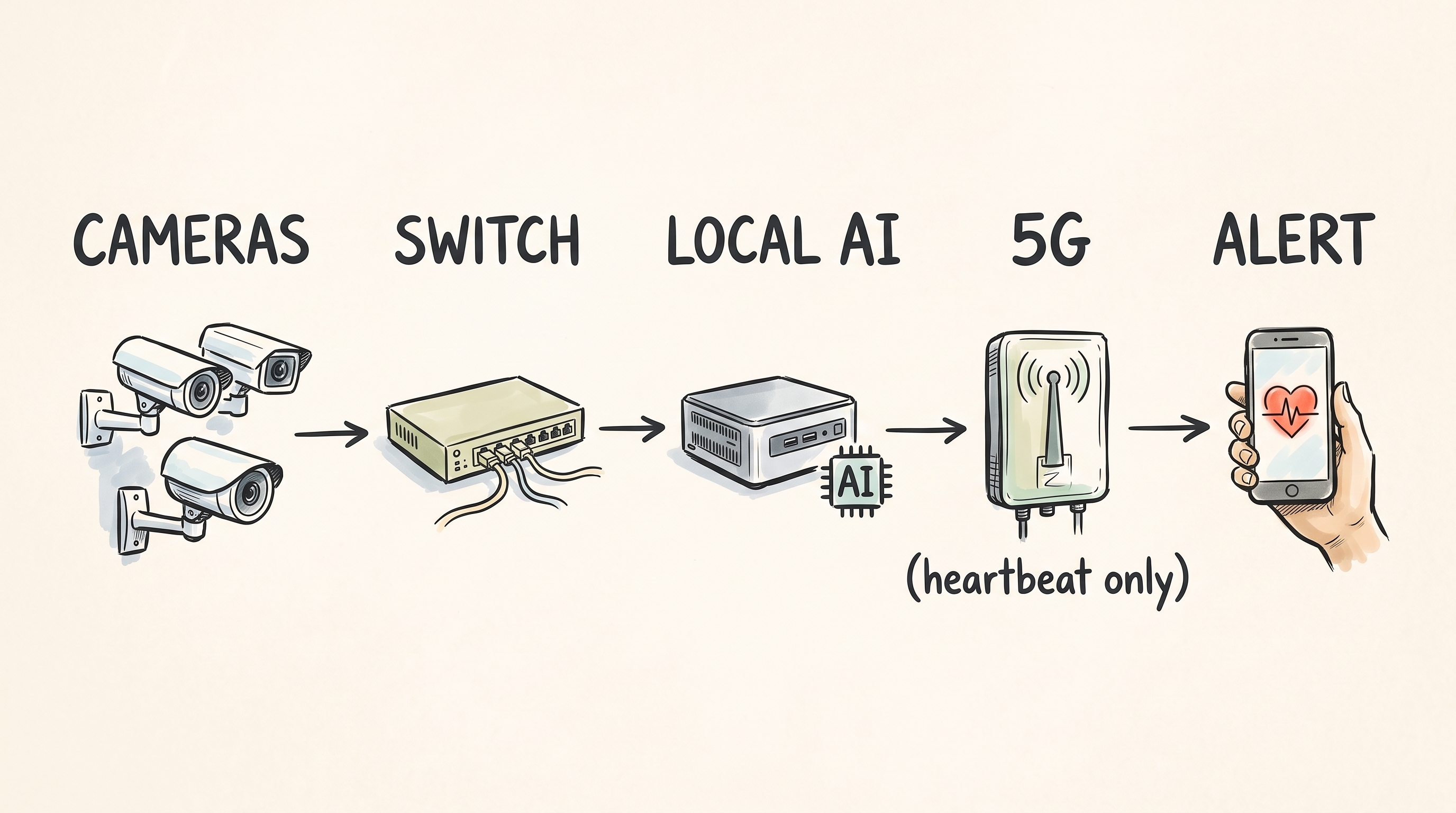
Why this matters:
- less dependence on customer IT
- predictable networking
- reduced attack surface versus cameras on everyday Wi-Fi
- no camera access from normal household or office devices
- independent cellular alerts
- simpler install: no port forwarding, no home Wi-Fi credentials for the cameras
If true at launch: core detection still runs locally even if the external connection is unavailable.
Rolling buffer and incident storage
Video is not retained as a diary of the day. A short encrypted rolling buffer (about 10–15 seconds) exists locally and is continuously overwritten. If a possible fall is detected, that window can be frozen, plus a short post-event period, as a local incident clip.
Access is meant to be authorized and logged. Retention is meant to be short. Ordinary footage is not uploaded to a video cloud.
Heartbeat and failure detection
A safety system has two jobs: detect the emergency, and detect when itself cannot detect the emergency.
Designed monitors:
- camera still delivering valid frames
- AI computer health / heartbeat
- missed heartbeats (lost cellular path)
- mains power lost for more than a defined period (example: five minutes) → notify
- recovery reported when power returns
We do not promise a UPS runtime until the hardware package is fixed.
Ilonai can know: a camera is offline, a heartbeat was missed, software version.
Ilonai cannot know remotely: what the person is doing in the room.
See also How it works, Privacy & Trust, and Evidence.