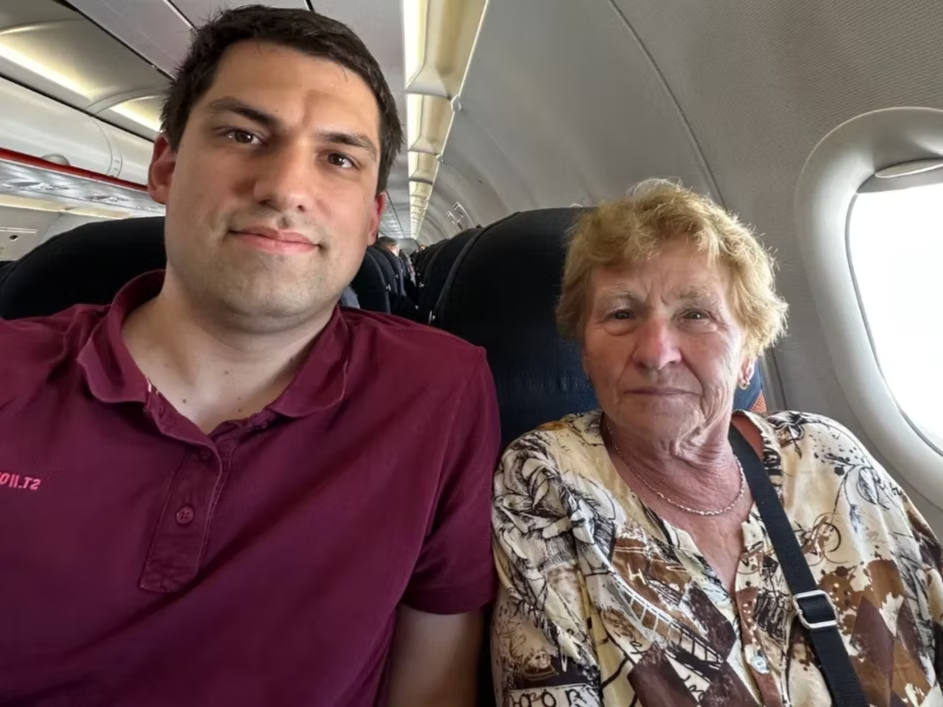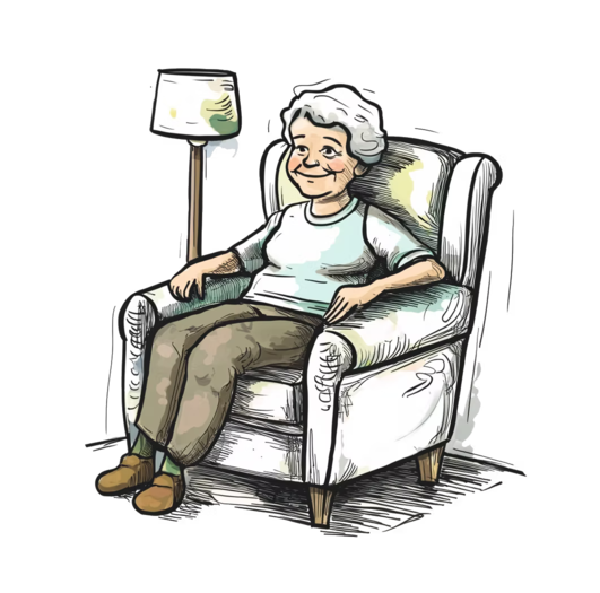
The problem is not only falling. It is falling when nobody knows.
An unwitnessed fall can leave someone unable to get help. A wearable only works if it is worn and can be activated. A normal indoor camera only helps if someone is watching it.
Ilonai is designed to notice a possible fall automatically and alert the right person — without giving anyone a permanent view into the home.
In Switzerland, the BFU reports that more than 1,700 people die from falls each year, 95% of them aged 65+, with nearly 6,500 serious injuries and around CHF 1.8 billion in economic costs.
On a normal day
- • AI processes locally
- • A short rolling buffer is overwritten
- • No image leaves
- • No one can watch live
- • No activity history is created
- • Only a tiny system-health heartbeat leaves
If nothing happens, no image leaves the system.
If a possible fall happens
- • AI flags an emergency locally
- • One confirmation image can go to a designated guardian or caregiver
- • A short pre/post incident clip can stay on the local box
- • That person decides what to do
A human is brought in only when help may be needed.
We deliberately do less.
Ilonai does not need to know how you spend your day to detect a possible fall.
Other care technology can measure sleep, movement, routines and room activity. Ilonai is being designed around a narrower purpose: detect a possible fall, get help, otherwise leave the person’s life alone.
Powerful AI. Kept local.
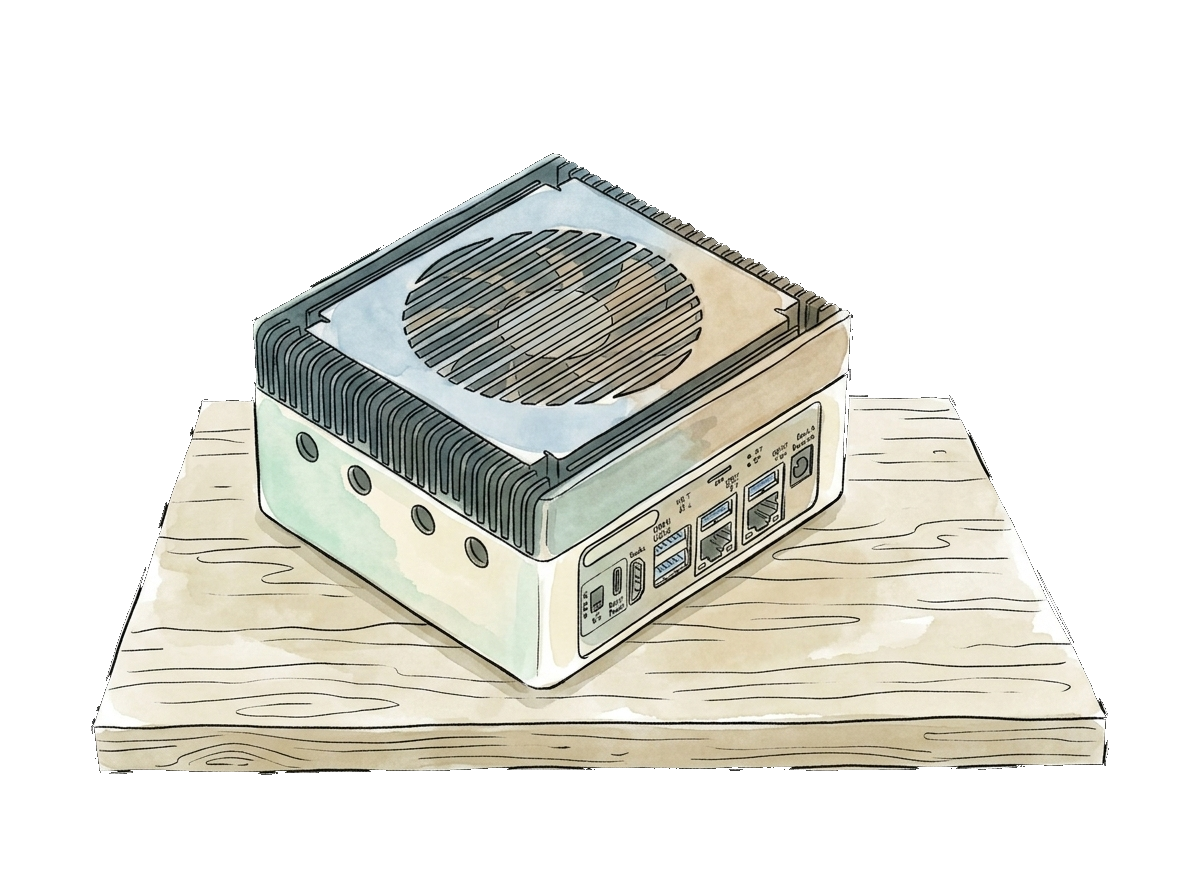
Typical network cameras must run very small models inside the camera, or send imagery to a cloud service. Ilonai uses a dedicated local AI computer, so the detector can use richer context while camera images remain inside the home or building.
This is not “smarter surveillance.” It is more capable visual reasoning with a tighter purpose.
Its own private safety network.
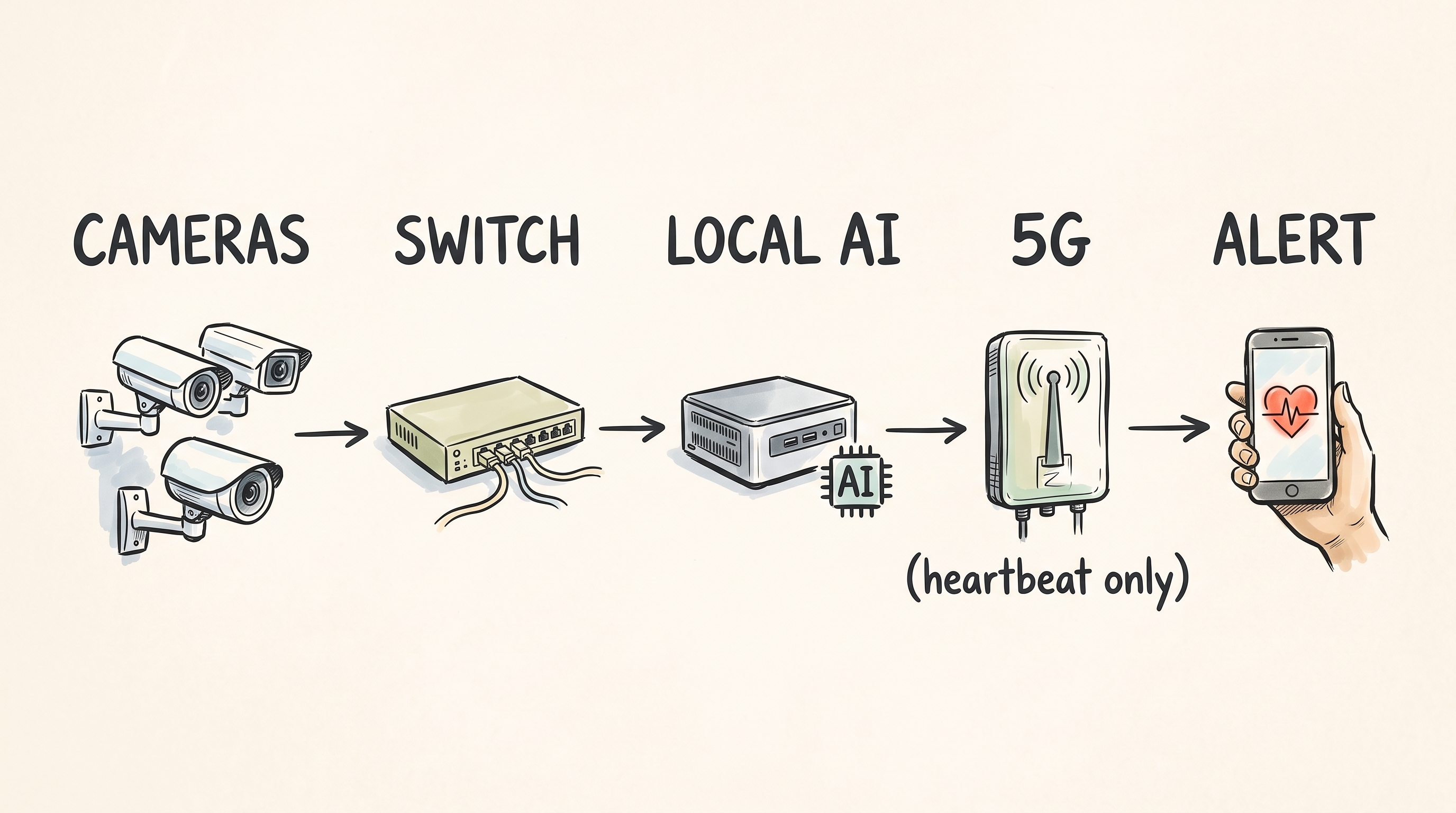
Approved PoE cameras connect to a local AI appliance over a dedicated wired network. An independent cellular connection is intended to carry only system status and emergency alerts.
No camera cloud account. No dependence on household Wi-Fi. No port forwarding.
Core detection is designed to keep running locally even if the external connection is unavailable.
A safety system should tell you when it stops working.
Silence should mean “everything is fine,” not “the system stopped working.”
Ilonai is designed to monitor camera availability, valid image delivery, AI-computer health, cellular heartbeat, and extended power loss. If protection is interrupted, guardians or staff should know.
Why Ilonai is different
| Wearable button | Normal smart camera | In-camera fall AI | Ilonai | |
|---|---|---|---|---|
| No action required after a fall | No | Depends | Yes | Yes |
| No wearable to charge or remember | No | Yes | Yes | Yes |
| No live human surveillance | Yes | Usually not the design | Varies | Yes, by design |
| No normal cloud video | Yes | Varies | Varies | Yes |
| Dedicated local AI compute | No | Usually cloud/vendor | Limited | Yes |
| Does not build a daily behavior profile | Yes | Varies | Varies | Yes, by design |
“Varies” means products in that category differ. We do not claim every competing product works the same way.
Choose your setting
For someone living at home
Independence without constant checking. Family cannot open a live camera feed. They are brought in only when the system believes help may be needed.
For homeFor a care facility
Scale fall detection without scaling surveillance. Standard PoE cameras, shared local AI, event-only visual access.
For care facilitiesIn development — and we will show the evidence as we earn it.
Ilonai is not installed in homes or facilities today. We are preparing a first real-home pilot. We will publish real-world detection sensitivity, false alerts, latency and uptime once those results exist.
We will not present development targets as clinical results.
All the detail
Normal day vs emergency, in plain language Technology
PoE, local AI box, isolated network, failure domains Privacy & Trust
What leaves the home — and what never does Privacy explainer
One page for residents and families Evidence
What we can claim now vs after pilots Pilot program
First home trial being prepared For home
Independence without constant checking For care facilities
Scale detection, not surveillance About
Ilona, Zug, and why the product is narrow FAQ
Short answers, same facts as the rest of the site For investors
In the footer; not the customer story Contact
info@ilonai.ch